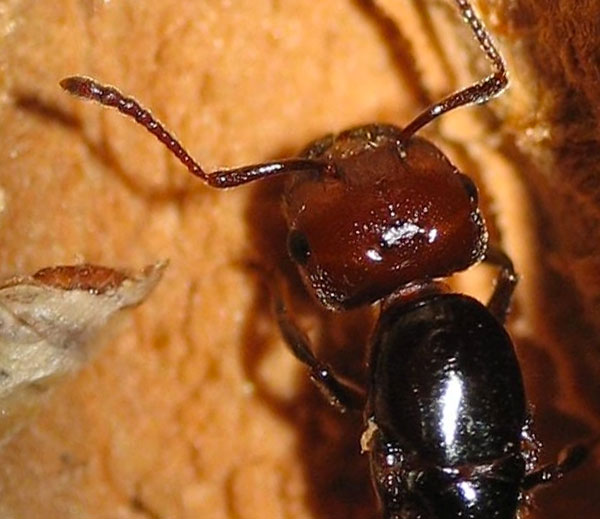
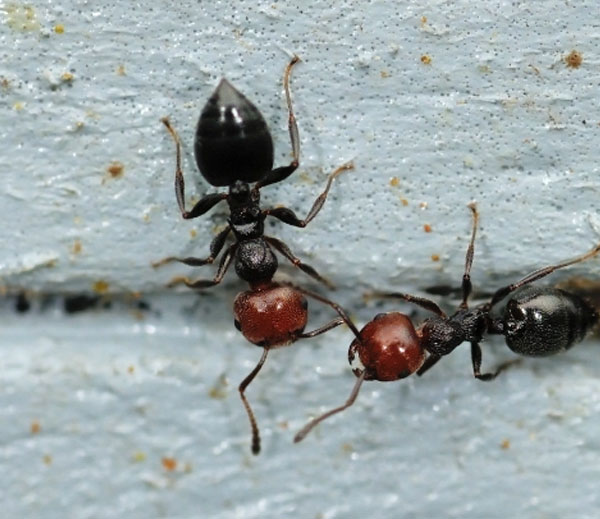
Crematogaster scutellaris, better known as the wood ant, can reach a length of about 8 mm in queens, while workers rarely exceed 5 mm.
These ants have a reddish head, with a black thorax and abdomen. The shape of the abdomen is distinctive, as it gradually narrows towards the tip.
When they feel threatened, they raise their pointed abdomen in a menacing posture, releasing a small drop of pheromones from the rear of the body. The pheromone odor triggers a general mobilization within the nest, and any intruder is quickly surrounded by a mass of aggressive ants.
Reproduction of wood ants
Crematogaster scutellaris establishes independent monogynous colonies, with the possibility of oligogyny (multiple queens may be accepted by the workers within the colony, although queens behave aggressively toward one another). Winged males and queens can be observed at the end of summer and, in some cases, even at the end of October if temperatures remain mild.
Colonies are usually built mainly in stumps, fallen trunks, or dry branches. Nests are made from a mixture of chewed wood and humus. Between March and October, workers mainly collect and transport sugary liquids and solid materials (arthropod remains, small insects, and similar).
Egg laying usually occurs during summer. This species is highly prolific. Larvae hatch mainly in September and overwinter in the second larval stage from November to February at around 10°C. The following spring, third-stage larvae develop and pupate in summer. Workers appear by mid to late summer, while sexual individuals emerge toward the end of August.
Wood ants can be rather cunning: some colonies raid the nests of other wood ant species and steal their brood. The stolen ants are then raised as workers within the colony.
Habitat: where they are found
This species is found mainly in Mediterranean regions and is therefore present in Europe, the Near East, and North Africa. Wood ants are known for building their nests in fields and open woodlands.
Not all members of the genus construct large above-ground nests, but those that do are remarkable builders. A colony of these small invertebrates can produce a dome-shaped nest reaching almost 3 meters in diameter and up to 140 cm in height. Nests are covered with straw, twigs, stems, blades of grass, and conifer needles. These structures absorb sunlight and help keep the ants warm.
Diet of the wood ant
These ants are natural predators of Thaumetopoea pityocampa, a moth that is a major pest of Mediterranean pine trees (especially Pinus halepensis).
They also carry live aphids into oak gall nests. It is not yet fully clear whether this serves a predatory purpose; it is therefore likely that the aphids are stored for overwintering or used as a food reserve by the wood ant.
Many of these ants protect insects called aphids because they produce honeydew, a sticky liquid that ants enjoy feeding on. Overall, however, wood ants are primarily predators of defoliating insects and are therefore considered beneficial to their ecosystems.