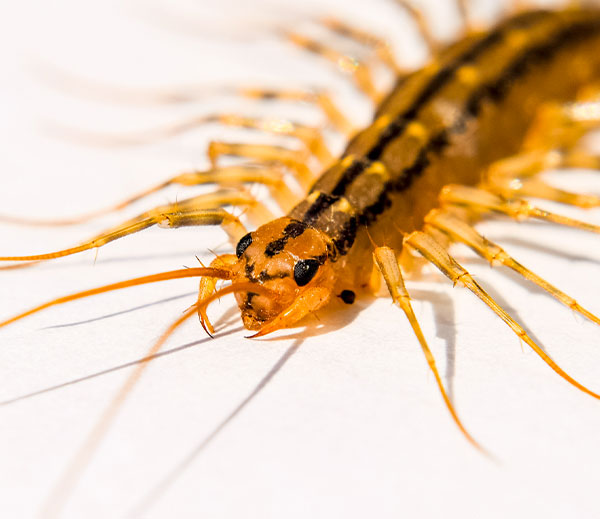
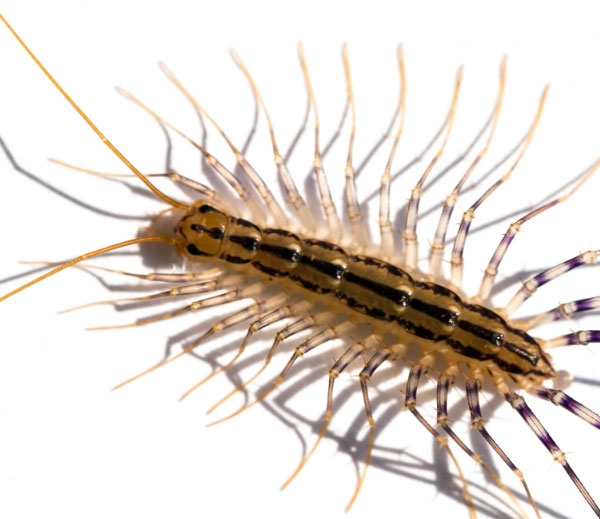
This species typically lives indoors, in damp areas such as basements, crawl spaces, cellars, and bathrooms—especially in winter. Like all centipedes, house centipedes are predators of other arthropods.
The house centipede belongs to the order Scutigeromorpha, commonly referred to as the house centipede group. It has a brownish-yellow body with a distinctive shape and up to 15 pairs of extremely long legs. House centipede legs are hooked, a structure that helps them hold onto prey. Three dark stripes run along the top of the body.
Unlike many other centipedes, house centipedes are not flattened from top to bottom and can run quickly. They measure about 2.54 cm in length, excluding legs and other appendages.
Reproduction of the house centipede
Centipedes do not undergo metamorphosis, although juveniles molt several times as they grow. They mate during warm months and remain dormant during winter. A centipede may live up to six years.
The reproductive cycle involves distinct rituals. The female releases pheromones to attract a male, which—depending on the species—may weave a silk pad and deposit a sperm packet called a spermatophore.
The spermatophore may be found and collected by the female or brought to her attention through a courtship “dance,” during which the male taps the female’s hind legs with his antennae. The reproductive cycle can produce up to 35 eggs.
Centipedes lay eggs in cavities within decaying logs or in soil. Most females care for their eggs and young, wrapping their bodies around the brood for protection. Eggs are prone to fungal growth and require grooming to reach maturity. However, some species may abandon or eat their eggs.
At hatching, many juveniles have fewer pairs of legs than adults and gain additional body segments and legs with each molt. Because centipedes have an exoskeleton, they must molt repeatedly, shedding their outer coverings.
Habitat: where it is found
This species usually lives indoors in damp areas such as basements, crawl spaces, cellars, and bathrooms—especially in winter when it moves inside. It patrols floors and walls in search of food and typically darts away when people approach.
Outdoors, it can be found under rocks and logs or in similarly protected locations.
Diet of the house centipede
House centipedes, like all centipedes, prey on other arthropods. Their diet includes cockroach nymphs, spiders, silverfish, crickets, bed bugs, flies, moths, and earwigs—many of which are considered household pests.
They subdue prey using venomous fangs. They do not bite humans easily, but if they do, the sting is generally no worse than a bee sting.