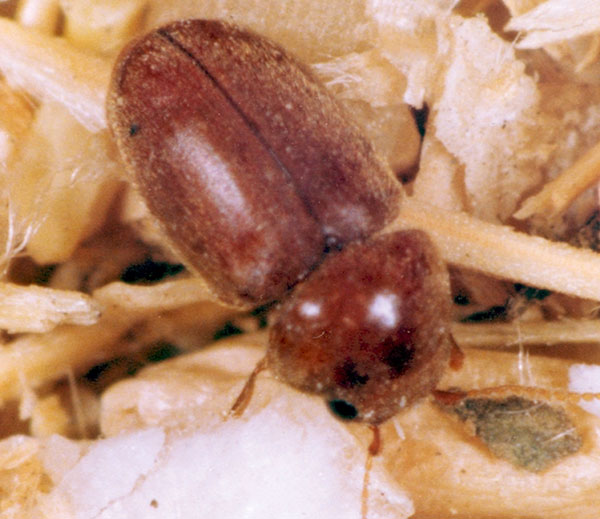
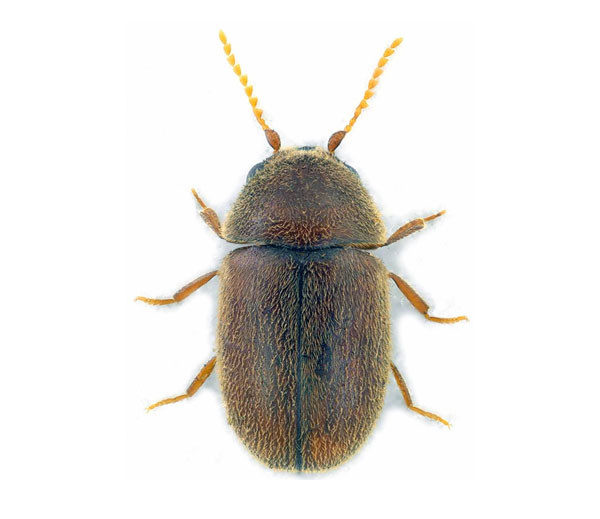
Lasioderma serricorne, better known as the cigarette beetle, is small, sturdy, oval, yellowish-reddish to reddish-brown, about 2–3 mm long.
The head is bent almost at a right angle to the body, giving the insect a hunched appearance when viewed from the side.
The wing covers are not striated, and the antennae are uniform in thickness from base to tip. Cigarette beetle larvae are whitish-yellow and grub-like, with three pairs of front legs, and a brown head capsule. The larvae are very hairy and measure about 2.5 mm when fully grown.
Reproduction of the cigarette beetle
Once adult, the cigarette beetle lives for 2 to 4 weeks. Adult females lay up to 100 eggs individually on food material. The eggs are white and oval-shaped and hatch in 6–10 days.
After hatching, the larvae tunnel through the food material, causing destruction and contamination. They reach full growth in 30–50 days and then enter the pupal stage, which lasts 8–10 days or longer, depending on temperature. Pupae are covered by a silken cocoon mixed with fragments of their food material.
The entire life cycle can take 45–50 days. Development from egg to adult is quite variable but generally takes 6–8 weeks under favorable conditions.
Habitat: where it is found
It is mainly found in mills, pet food plants, bakeries, chocolate and confectionery factories, as well as facilities producing cereals, spices, and snacks—and, of course, in tobacco manufacturing and storage environments.
Diet of the cigarette beetle
They feed on a wide variety of foods, including grains, coffee beans, spices, rice, dried fruit, animal-based products, and pet food. They can even chew through cardboard boxes and food packaging, which is why only items stored in airtight containers are fully protected from these pests.