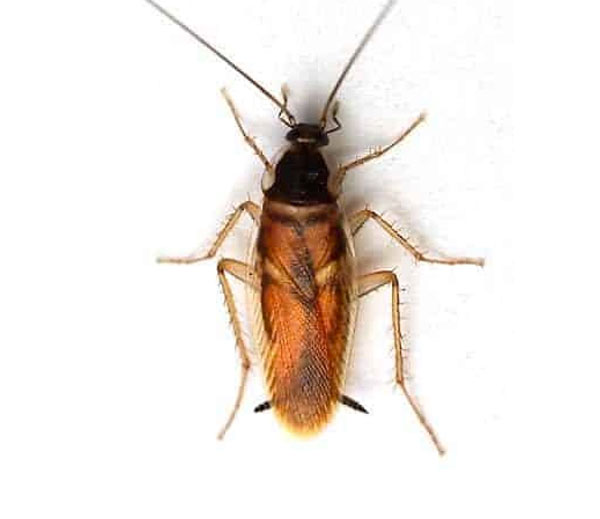
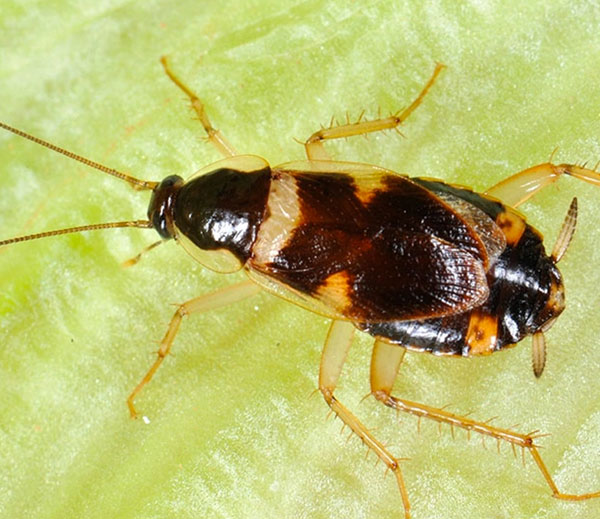
Supella longipalpa, commonly known as the brown-banded cockroach, is one of the most common pest insects found in homes, schools, and businesses.
They feed on many of the same foods consumed by humans and are particularly troublesome because they infest areas where food is prepared or served. They are also capable of transmitting disease-causing organisms.
These cockroaches have flattened bodies and heads that, when viewed from above, are hidden by a plate-like structure called the pronotum. They move surprisingly fast thanks to their long, spiny legs. Their long, thin antennae help them locate food and navigate in the dark, when they are most active.
They can vary in color from brown and black to light brown, reddish-orange, or pale green. Most species have wings which, in some cases, are short and non-functional.
Reproduction of the brown-banded cockroach
The life cycle of the brown-banded cockroach lasts on average 161 days. Males develop faster than females. The egg capsule (ootheca) is yellowish to reddish-brown and measures about 5 mm.
The female carries the egg capsule for 24–36 hours before attaching it to an object. Egg cases may be glued to desks, tables, other furniture, and even bedding. This habit largely explains the widespread distribution of this species.
Each egg capsule can contain up to 18 eggs. Gravid females develop a noticeably enlarged abdomen. The average incubation period is about 69 days, and females produce more egg capsules during the summer months.
Habitat: where they are found
Brown-banded cockroaches are found in houses, apartments, hotels, and hospitals. They are less common in shops, restaurants, and kitchens. They frequently infest furniture and can spread rapidly throughout an entire building.
They typically hide on ceilings, high on walls, behind picture frames, and near the motors of refrigerators and other appliances. They are also found inside light switches, closets, and furniture.
Unlike the German cockroach, they require less humidity, which explains why they are often found in rooms other than kitchens or bathrooms. These cockroaches avoid light and are rarely seen during the day.
Diet of the brown-banded cockroach
Brown-banded cockroaches are not picky eaters. As omnivores, they consume almost anything, including both plant and animal matter, allowing them to infest kitchens and food storage areas.
They primarily feed on sweets, starches, and animal proteins, but also consume fatty foods, cheese, and anything moldy or fermenting. Sugary foods should always be stored in airtight containers.
Work surfaces, bread counters, and meat preparation areas must be cleaned thoroughly, especially in commercial environments. Cleanliness is a vital part of cockroach prevention, as decomposing matter strongly attracts them, including waste, garbage, plants, soap, cosmetics, and even human waste.