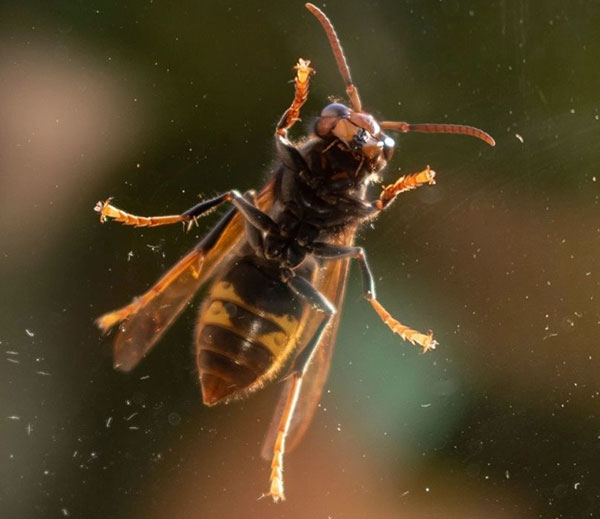
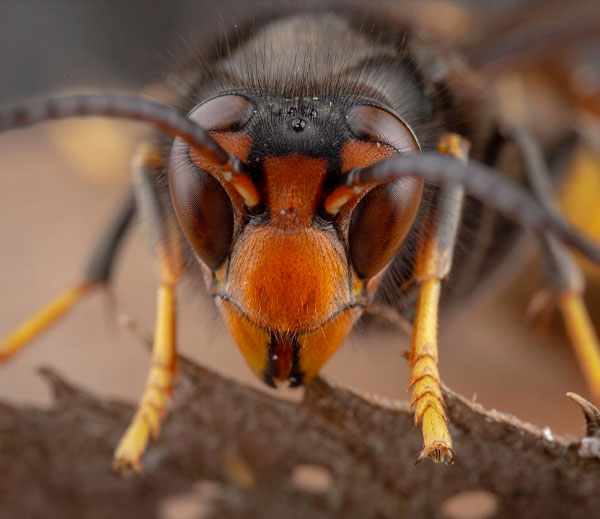
It first arrived in France in 2004 and spread rapidly. As a highly effective predator of insects—including honeybees and other beneficial species—it can cause significant losses to bee colonies, native species, and potentially entire ecosystems.
The areas where it is most likely to be found include southern England (as it may cross the Channel from France) or within imported goods such as potted plants, soil, cut flowers, fruit, and timber. The Asian hornet is active from April to November, with peak activity in August and September.
Adult worker hornets measure approximately 25 mm in length, while queens reach about 30 mm. The abdomen is mostly black, except for the fourth abdominal segment, which features a yellow band toward the rear. The legs are characteristically yellow, which explains the common name “yellow-legged hornet,” and the face is orange with reddish-brown eyes.
Reproduction of Vespa velutina
After overwintering, the queen emerges in spring and searches for a sugary food source to build up energy before constructing a small embryonic or “primary” nest. During this phase, she is alone and vulnerable, but soon begins laying eggs to produce the first workers.
As the colony and nest grow, a larger nest is established around the original one or relocated elsewhere. During the summer, a single colony can produce an average of 6,000 individuals per season.
From July onward, predation on honeybee colonies increases and continues until late November. Asian hornets hover at hive entrances, waiting for foraging bees to return—a behavior known as “hawking.” Once captured, the bee is usually decapitated, and the protein-rich thorax is taken away. The larvae require animal protein, which is processed into meat pellets and fed to them.
Habitat: where it is found
The Asian hornet originates from Southeast Asia and was likely introduced accidentally through imported goods from China. Since its first record in France in 2005, it has spread to Spain (2010), Portugal and Belgium (2011), Italy (2012), Germany (2014), and Great Britain (2016).
Its preferred habitat is often near beehives, in trees, or on man-made structures. Nests are typically located at significant heights, both in trees and on artificial structures.
Diet of Vespa velutina
The Asian hornet poses a serious threat to beekeeping, as its primary food source consists of honeybees. This is why colonies often establish themselves near apiaries. Captured bees are killed and decapitated, and their bodies serve as the main nutritional source for the hornets.