These beetles damage clothing, furnishings, and other human-made products. Infestations develop quickly and often go unnoticed until damage is widespread.
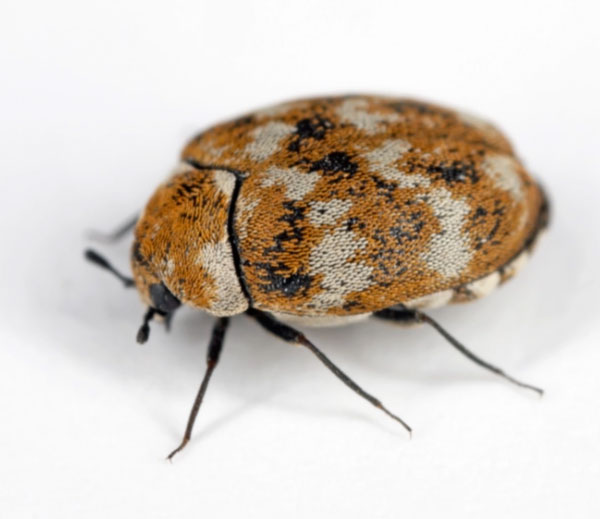
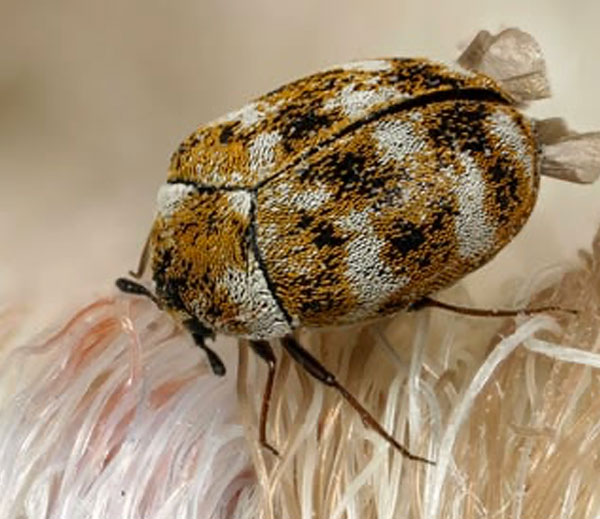
Anthrenus verbasci is a small (1.5–3.5 mm), round beetle with wing covers (elytra) covered in white, golden-yellow, and black scales forming a mottled pattern. The legs are black, the head is small and mostly hidden beneath the upper thorax (about half of the beetle’s body). The eyes are large and black. The antennae are club-shaped, with an enlarged tip composed of the upper antennae and two protruding lower segments.
The larvae are commonly called “woolly bears” because their bodies are covered with hairs. The larva has unevenly colored tergites (the dorsal plates covering the body segments): the central ones are light brown, while the three thoracic tergites just behind the head and the last four abdominal tergites are noticeably darker. The head ranges from light brown to orange, even when the tergites are dark. The last three abdominal segments bear dense backward-pointing tufts of special hairs characteristic of the genus Anthrenus.
Reproduction of the carpet beetle
Like other insects, carpet beetles go through four life stages: egg, larva, pupa, and adult. Females lay eggs on or near a food source—materials containing chitin and keratin. Larval growth periods are followed by diapause (a resting phase), which helps outdoor populations synchronize with seasonal changes.
Adults usually emerge during the warmer months, when their preferred food—pollen—is available. Larvae require temperatures between 15 and 25 °C to develop. During winter, larvae enter diapause. Adults generally require two summer seasons to fully develop, with pupation occurring in the second spring. Indoors, however, the entire life cycle can be completed within one year. Adults live between two and six weeks.
Habitat: where it is found
A cosmopolitan species, the carpet beetle is found in Europe, North America, Australia, and other regions. It is native to Great Britain and is more common in the London area and southern counties. Larvae are typical household pests of woolen items or museum pests, but they also live in bird and mammal nests.
Adults visit flowers to feed on pollen and nectar and are often found indoors on windowsills, attempting to exit. Occasionally, the species is introduced via imported dried fruits and nuts.
Diet of the carpet beetle
The larvae feed mainly on animal and plant materials such as fur, hair, silk, wool, and feathers, causing damage to clothing, furniture, and other household items. Although larvae prefer organic materials, they will also consume synthetic fibers contaminated with oils, sweat, or food stains.
They may also feed on grains, spices, nuts, cereals, and other milled products. Larvae can consume animal hair, dead animals, and insects. While larvae feed on natural fibers, adults feed primarily on plant nectar and pollen. Larvae search for food in dark, hidden areas.