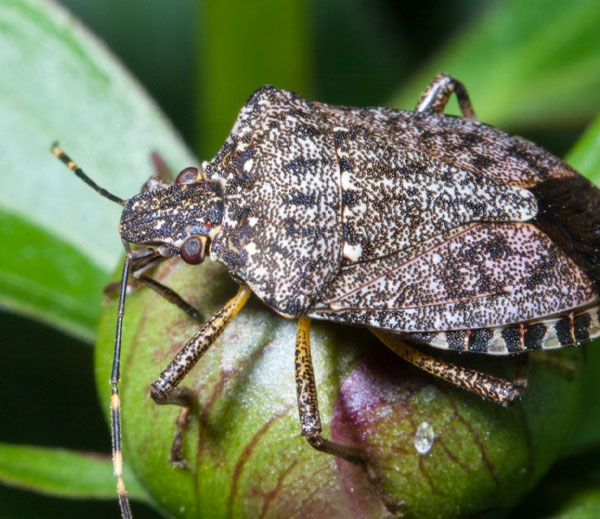
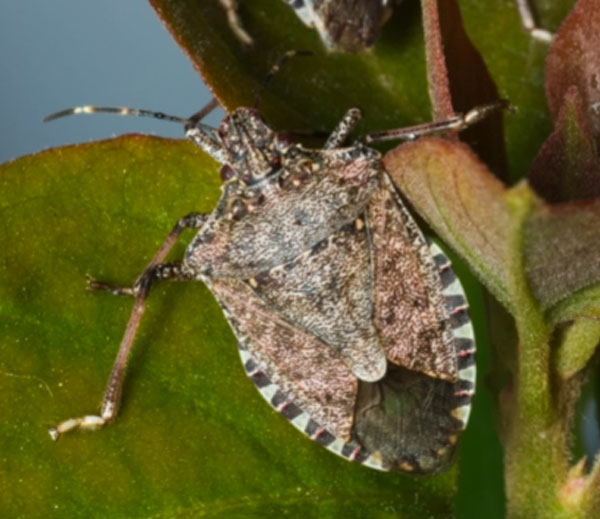
The Halyomorpha halys, commonly known as the brown marmorated stink bug, has a shield-shaped body typical of all stink bugs.
Adults are approximately 17 mm long and have a mottled gray-brown coloration. The penultimate (4th) antennal segment features a distinctive white band. Several abdominal segments protrude from beneath the wings and are alternately banded black and white. The underside of the body is white, sometimes with gray or black markings, and the legs are brown with faint white bands.
The brown marmorated stink bug has five nymphal stages and ranges in size from 2.4 mm to 12 mm during development. Unlike adults, which camouflage well against tree bark, nymphs are more brightly colored with red and black markings. Early instars, which resemble ticks, are not very active and remain near the egg mass after hatching. Nymphs have dark reddish eyes, a red-yellow abdomen striped with black, and black legs and antennae with white bands.
Reproduction of the brown marmorated stink bug
Like many stink bug species, brown marmorated stink bugs share similar life cycles. In spring, fertilized females lay egg masses on plant stems and leaves.
Development occurs through incomplete metamorphosis, consisting of three stages: egg, nymph, and adult. Nymphs are wingless and pass through five growth stages, each lasting approximately one week. As they progress, they increase in size and eventually become fully winged, reproductive adults.
Both nymphs and adults feed on plants and fruits. Adults continue feeding and reproducing throughout the summer. Depending on location and environmental conditions, multiple generations may occur each year, with females laying up to 400 eggs during their lifetime. Adults typically live between 6 and 8 months.
Habitat: where it is found
The brown marmorated stink bug is a polyphagous herbivore with a wide range of host plants. It is commonly found in unmanaged areas with plants such as tree-of-heaven, black walnut, and cherry species, as well as in managed areas with vegetables, ornamental plants, small fruits, and fruit trees.
Due to its broad host range and strong dispersal ability, it typically feeds on leaves and fruiting structures, causing direct damage to crops.
Diet of the brown marmorated stink bug
The brown marmorated stink bug feeds on a wide variety of host plants and fruits, including apples, stone fruits such as peaches and apricots, figs, mulberries, citrus fruits, persimmons, as well as crops such as beans, corn, tomatoes, soybeans, and many ornamental plants and weeds.