House mice are major economic pests: they consume and contaminate crops and human food and host a range of diseases and parasites infectious to humans.
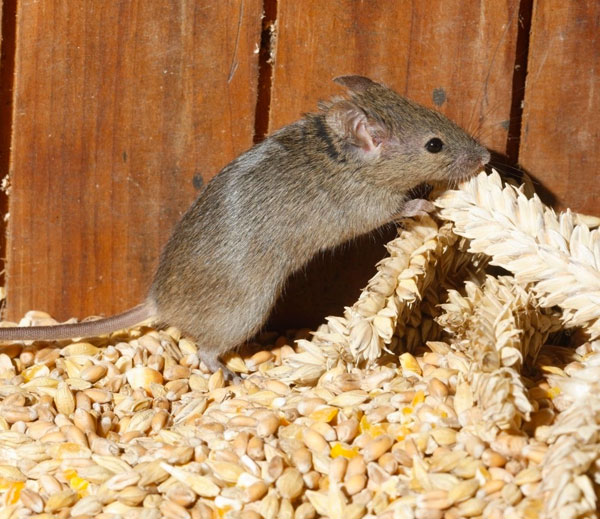
Mus musculus, commonly known as the house mouse, has a total body length of 160–200 mm. The tail measures 78–94 mm, and the hind foot measures 17–20 mm. The average adult weight is 15–24 g. The skull length ranges from 20.4 to 22.5 mm, with a width of 10.4 to 11.5 mm.
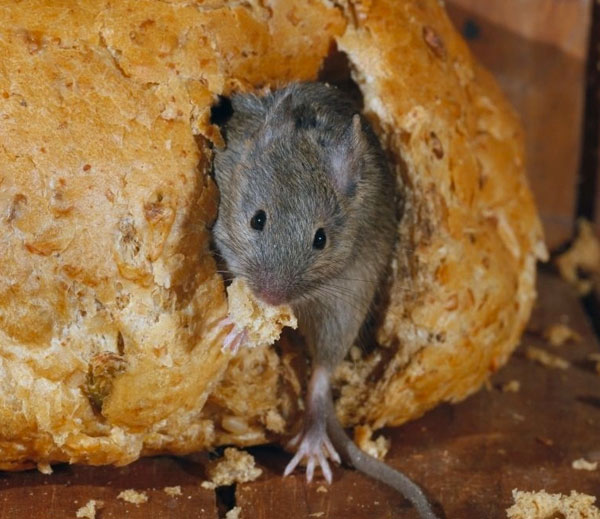
It is a small mouse with a thin, tapered tail. The tail is hairless and scaly, with circular ring-like markings. The ears of Mus musculus are large and hairless. The nose is pointed, and the fur is straight. The fur color is yellowish-brown on the upper parts and grayish on the underside.
Reproduction of the house mouse
Mus musculus is a short-lived mammal that usually lives about two years, and longer in captivity. Females give birth to an average of five to six young per litter. Gestation lasts 18–19 days, and females are ready to mate again just 12–18 hours after giving birth.
Females may produce one litter per month. Birth peaks occur in April–May and again in August–September. If the female lives outdoors, reproduction may stop during winter. Young are born naked and blind and begin to resemble adults at around 14 days. They are weaned at three weeks, and females reach sexual maturity at eight weeks.
Diet of the house mouse
The house mouse is omnivorous and has a varied diet. It feeds on fruits, grains, fatty foods, both animal and plant-based, including cheese, fish, insects, cured meats, lard, and nuts. It does not require free-standing water.
Habitat: where they are found
When living alongside humans, Mus musculus nests inside walls, storage areas, or any sheltered location close to food sources. Although mice are rarely seen, signs of their presence include gnawed packaging, crumbs, and droppings near food supplies. Nests are made of rags, paper, or any soft, shreddable material.
Most house mice living with humans are active during the day. In the wild, Mus musculus is mostly nocturnal and lives in underground burrows with tunnel systems. It is an excellent runner, climber, jumper, and swimmer, but usually remains close to its nest. It carries several internal and external parasites and is susceptible to multiple diseases that can be transmitted to humans.