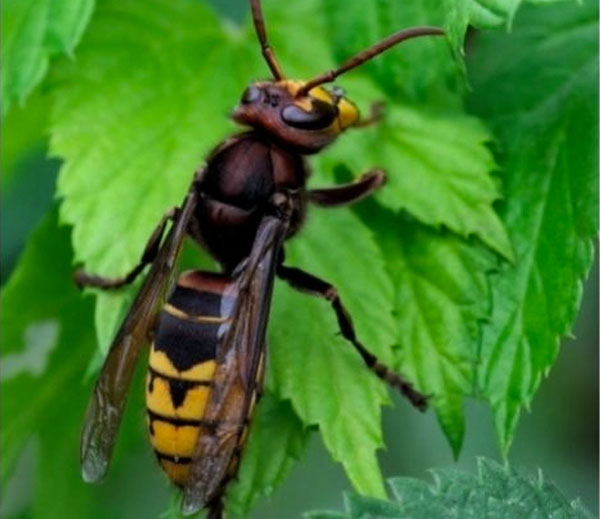
Vespa crabro, commonly known as the European hornet, is found throughout Europe. Queens reach about 3.5 cm in length, while workers measure around 2.5 cm. Their coloration ranges from yellow-orange to reddish-brown.
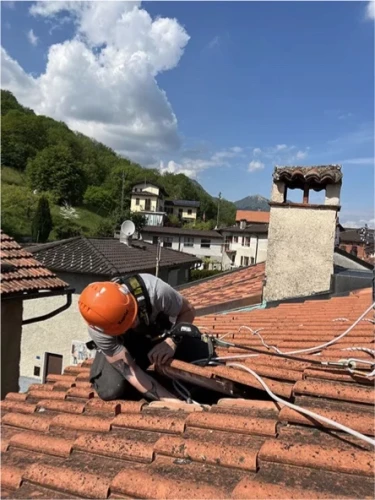
This insect is found both in lowland and hilly areas, more frequently in southern and central regions. Vespa crabro is a predator of various insect species, including honeybees. It prefers to nest in hollow trees, wall cavities, chimneys, and attics.
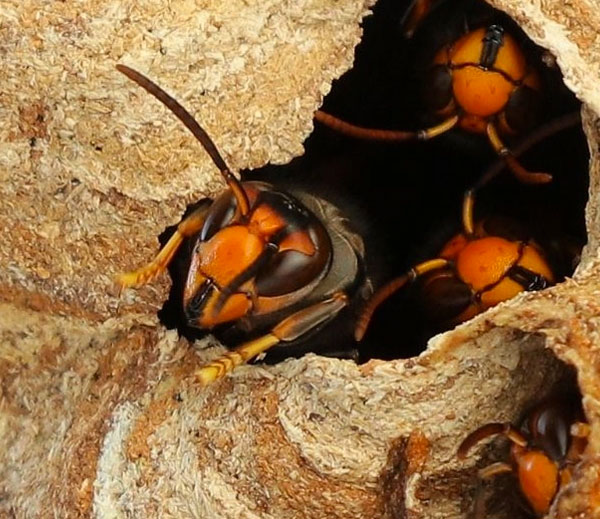
The nest is made of a light-brown, paper-like material and is relatively fragile. Colonies usually consist of a few hundred adults at peak development.
Reproduction of the European hornet
European hornets build paper nests like other hornets. However, unlike bald-faced hornets, which construct large exposed nests in trees, or yellowjackets, which typically nest underground, European hornet nests are located in sheltered areas such as large hollow trees and sometimes inside wall voids of buildings.
Because they usually nest in hollow trees, European hornets are most commonly found in forests and adjacent areas. They may also occur in parks and suburban environments where suitable nesting sites are available. Occasionally, underground nests have also been reported.
European hornet nests are often large due to the size of the insects themselves, but most nests contain only 1,500–3,000 cells. By mid-September, the nest reaches its maximum size, typically housing 200–400 workers, although large nests may contain up to 1,000 workers.
Like other social wasps, European hornets build annual nests. This means that the nest and workers die in autumn, and only fertilized queens survive to establish new nests the following year. Therefore, the presence of a nest in a specific tree or location does not necessarily mean it will be reused in subsequent years.
Fertilized queens overwinter in protected places such as beneath the bark of fallen trees or within wall cavities. When they enter buildings and awaken in spring, they may accidentally move indoors instead of exiting, sometimes ending up in attics or living spaces.
Habitat: where they are found
Vespa crabro can be found in open areas with trees, forest edges, gardens, urbanized areas, hollow or artificial trees, floors, attics, walls of old buildings, barns, and wood shelters. Rarely, they may also nest in underground cavities.
Diet of the European hornet
European hornets are predators for most of the year and hunt other insects such as grasshoppers, various flies, and yellowjackets. They sometimes prey on honeybees, a behavior that appears to be more common in Europe than in other regions where they have been introduced.
They also consume sugars and carbohydrates, especially in autumn. They are attracted to fallen fruit such as apples and pears and may strip bark from shrubs (particularly lilac) to feed on plant sap. Bark stripping can cause twigs and branches to dry out.