Flies of the genus Psychoda do not bite and are not capable of transmitting any known pathogens; however, large infestations of drain flies can cause respiratory problems.
Psychoda alternata is a moth species belonging to the family Psychodidae. The larva is semi-aquatic and lives in the gelatinous slime associated with wastewater effluent leaks, in drains and in trickling filter systems.
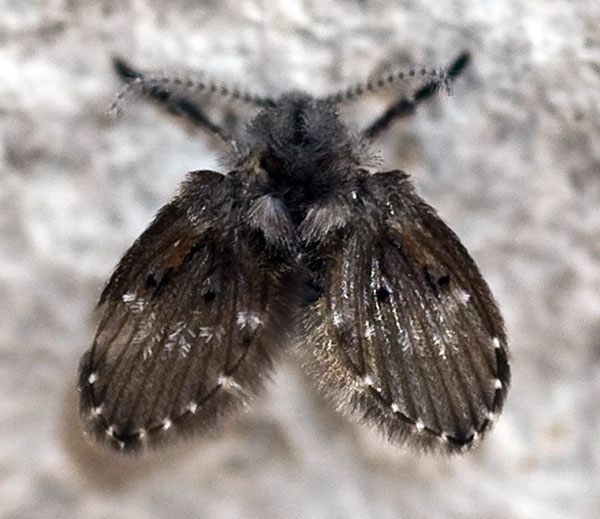
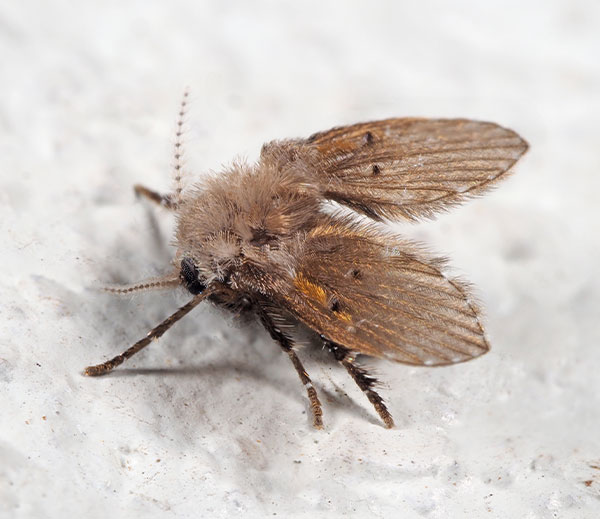
The adult female is about 4 mm (0.2 inches) long, while the male is slightly smaller. The wings are broad and held away from the body at an angle. They are covered with dense, hair-like tufts along the veins and are gray with a mottled appearance.
The wing muscles are relatively weak and these insects mostly run or hop, occasionally making short flights. Males emerge first and survive only a few days, while unmated females may live for up to a week.
Reproduction of drain flies
Eggs are laid in moist areas where the larvae will feed. Up to 100 eggs are laid by the female, sometimes individually but usually in gelatinous clusters of 15 to 40. The eggs are translucent and less than one millimeter in diameter.
They hatch in about two days at 21°C (70°F). The larvae are slender, whitish, cream-colored or light brown, with a head equipped with strong mandibles, 11 body segments, and siphons on the two posterior segments.
The larval stage lasts about 15 days at 21°C, during which the insect often overwinters in diapause. Pupae range from yellowish brown to brown and breathe through horn-like structures located at the head end. The pupal stage lasts one to two days. Both larvae and pupae are usually found within the top 2.5 cm of the substrate.
Habitat: where they are found
These insects are native to North America but have since spread widely throughout the world. Larvae develop in moist areas rich in organic matter such as drains and trickling filter systems, as well as ditches and decomposing organic sludge.
Adult insects rarely move far from their place of origin. They are commonly found resting on bathroom walls, outside buildings, and in showers near suitable larval habitats. Larvae feed on the moist organic film that can accumulate inside drains.
Nutrition of drain flies
Drain flies feed on organic matter and sewage.