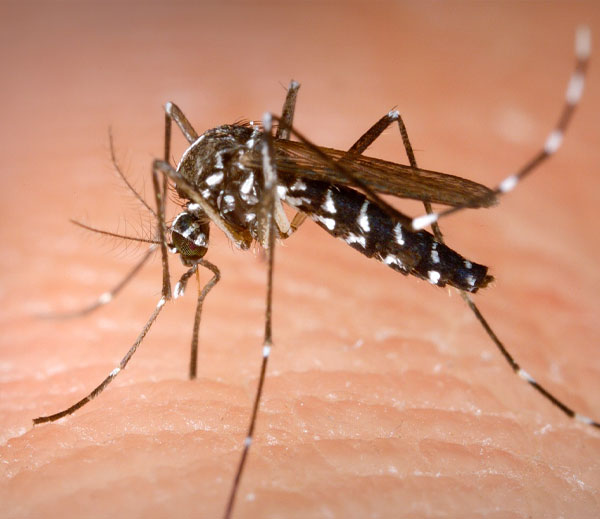
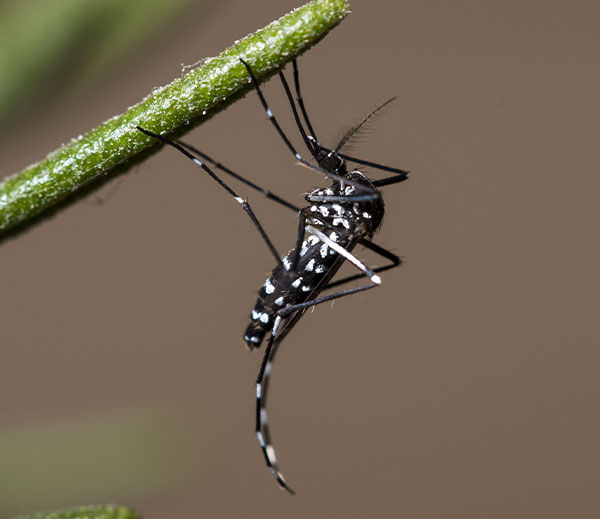
The tiger mosquito feeds mainly during the day on multiple hosts, including humans. It is a potential vector of encephalitis, dengue, yellow fever, and dog heartworm.
Aedes albopictus is better known as the Asian tiger mosquito. Adults of this species have black bodies with conspicuous white stripes. A single distinctive white stripe runs along the back. Body length is about 5 millimeters.
Silvery-white bands are visible on the palps and tarsi. The eggs are about 1 millimeter long and range in color from dark brown to black.
Eggs are laid in moist areas just above the water surface and can overwinter. They hatch when flooding occurs, and the immature stages (larvae and pupae) of the life cycle take place in water.
Larvae are found in standing water. Pupae are comma-shaped and dark brown in color.
Reproduction of tiger mosquitoes
Female tiger mosquitoes lay 40 to 150 eggs after a blood meal. The blood-feeding and egg-laying cycle continues throughout the mosquito’s lifetime. Egg-laying occurs about once a week.
The maximum number of eggs laid over a female’s lifetime is about 300.
Adult tiger mosquitoes live from a few days to several weeks, depending on weather conditions. Hot, dry weather reduces life expectancy.
Regardless of lifespan, adult tiger mosquitoes rarely move far from the containers where they were born. Most adults are found within a few hundred meters of the breeding container.
Habitat: where they are found
The tiger mosquito is native to Southeast Asia and has spread along major transport routes through human activity, especially via the commercial movement of used tires.
Although introductions at ports and nurseries have been controlled, this species continues to pose a public health threat.
Likely invasion mechanisms include introduction into standing water, closed containers where water pools, or via desiccation-resistant eggs associated with previously stagnant water.
Diet of the tiger mosquito
Males of the species are not parasites. They feed on nectar and sugar-rich plant juices.
Females also feed on these juices, but they need a blood meal to develop their eggs.
Tiger mosquitoes are efficient feeders and can take blood from many different species (mammals and birds). They primarily prefer mammals.
Some of the most common hosts include dogs, deer, rabbits, and humans. They may also feed on squirrels, opossums, cattle, raccoons, turtles, rats, and cats. This host range allows the species to thrive in a wide variety of environments.