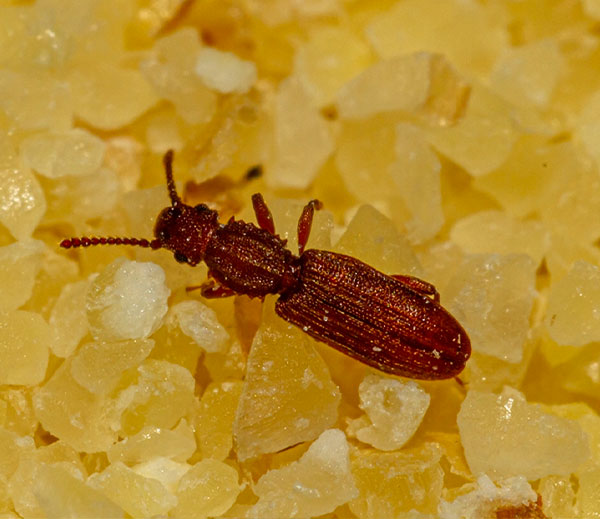
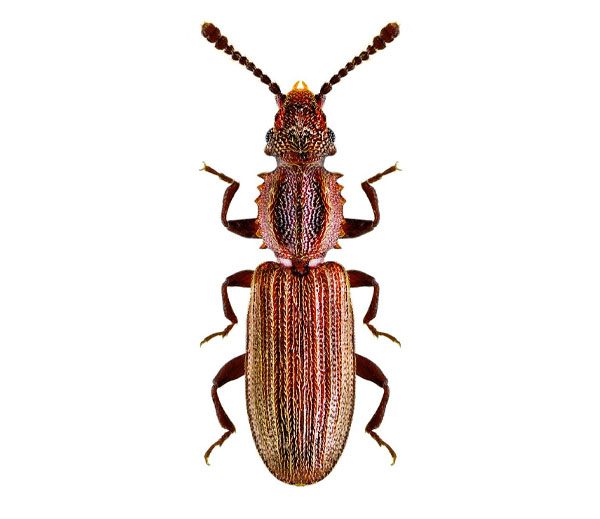
The sawtoothed grain beetle is one of the most widespread pests of stored products and can be found at the production, storage, or retail level. It can be present both in pantry food products and in adjacent rooms.
Oryzaephilus surinamensis, known as the sawtoothed grain beetle, originates from the Americas, although it has since spread throughout the world. As an adult, it measures about 2.5 mm in length. The body is very flat and well adapted for slipping into cracks and crevices. It is easily identifiable. The margins of the thorax are saw-like and have six projections on each side.
In addition, there are three longitudinal ridges on the upper surface of the thorax. A tooth on the femur of the hind leg distinguishes the male from the female. The wings are well developed, but this insect does not fly. A closely related species, the merchant grain beetle, can fly and is more commonly found in warmer climates.
Reproduction of the sawtoothed grain beetle
Eggs are laid singly or in small masses in food. They may be deposited in cracks or freely. The average number of eggs is 350–400 per female. Eggs hatch in 3–5 days. Within a few hours of hatching, larvae begin feeding. There are usually three larval stages. In preparation for pupation, the larva attaches itself to a fixed object.
The pupa forms in a rough cell made of food particles. The larval exoskeleton is shed but remains attached in the pupal cell. The pupa has the same six projections on each side of the thorax. Under optimal conditions, development from egg to adult can occur in about 25 days.
Adults and larvae are resistant to low temperatures, surviving up to 3 weeks of exposure at 0°C. Lethal temperatures for all stages range around –15.6°C with an exposure time of 24 hours. Upper temperature limits for development range between 37.5 and 40°C, while the optimal temperature is about 30–35°C. Eggs hatch in about 3–5 days, the average larval period lasts 12–15 days, and the pupal stage lasts 4–5 days.
Oviposition usually begins during the first week of adult life and peaks during the second or third week. After 10 weeks, the rate of egg laying declines rapidly. The average lifespan of mated females ranges from 4 to 19 weeks; however, some females are known to live for more than 7 months.
Adults are generally very active and tend to migrate away from the food source when populations become too large.
Habitat: where it is found
The sawtoothed grain beetle is one of the most widespread pests of all stored products and may be present at the production, storage, or retail level. It can be found both in pantry food products and in adjacent rooms.
Infested foods include cereals, flour, pasta, dried fruit, dried meat, candies, and other similar packaged products. As with other pantry insects, larvae cause most of the damage, but adults are more commonly encountered. Adults can easily enter sealed cardboard boxes and soft plastic packaging.
Diet of the sawtoothed grain beetle
This insect feeds on cereals, dried fruit, bran, oats, brown rice, nuts, breakfast foods, macaroni, sugar, spices, fried meat, chocolate, and tobacco.
It cannot attack perfectly intact grain but can feed on slightly damaged grain. Therefore, it is often found in whole grains in association with other insects. It also feeds on eggs and dead adult moths.