Grain weevils are found in all temperate and warm-temperate climates and are widely distributed throughout Europe. Both adults and larvae are cold-resistant.
Adult grain weevils
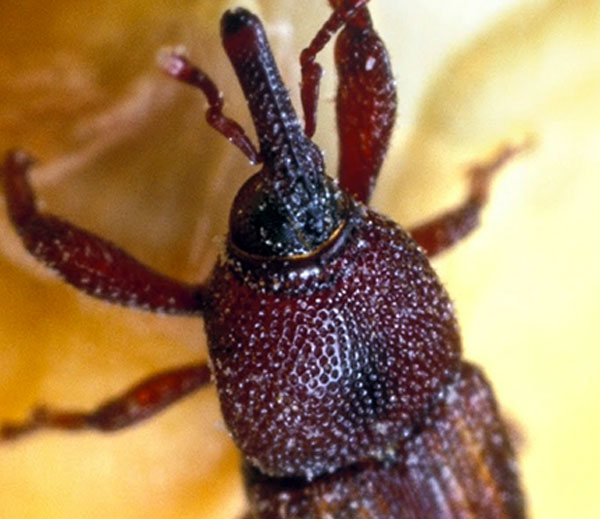
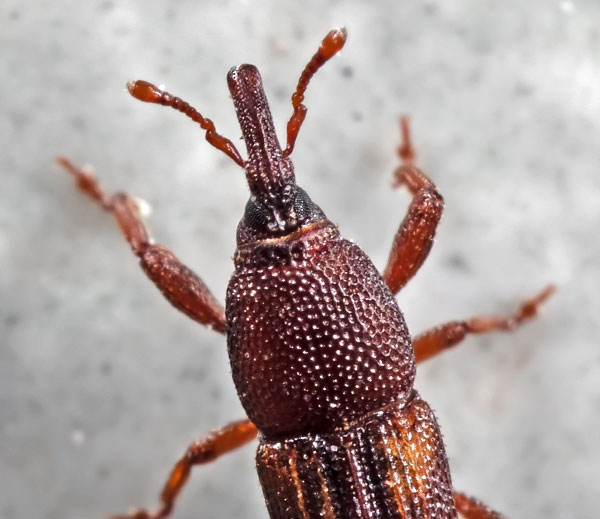
Adult granary weevils can vary considerably in size, ranging from 2.5 to 5.0 mm in length, although 3 to 4 mm is considered average.
They have the characteristic rostrum (snout or beak) and elbowed antennae typical of the Curculionidae family. They are shiny, reddish-brown to black in color, and marked with numerous punctures. The punctures on the thorax are irregular, while those on the elytra (wing covers) are arranged in rows.
The body is sparsely covered with short yellow hairs. The antennae have eight segments and are often held extended while the insect walks. Weevil larvae are white, fleshy, and legless.
Grain weevil reproduction
The average lifespan of the grain weevil is 7–8 months. Females usually lay about 150 eggs, and up to 300 eggs over their lifetime. Eggs are laid individually inside cavities that the female chews into grain kernels.
The cavities are sealed with a waxy plug secreted by the female. Eggs incubate for about 4–14 days, depending on temperature and humidity. One larva develops inside each infested grain.
The feeding larvae tunnel through the grain and continue feeding until only the husk remains. There are four larval stages, all occurring inside the grain. Pupation also takes place inside the grain.
The newly emerged adult chews its way out of the grain, leaving a characteristic large, roughly rectangular exit hole with jagged edges. After exiting the kernel, the female releases a sex pheromone to attract males for mating.
Under warm conditions, the life cycle can be completed in 4–6 weeks, but may extend up to 21 weeks in winter. Adults can survive for a month or more without food under cooler conditions. This species cannot fly but is capable of traveling relatively long distances.
Habitat: where we find them
The grain weevil is found in warehouses and storage facilities used for grain storage, in processing facilities where grain passes through even in small quantities, in mills, and in ship holds.
Grain weevil diet
Grain weevils feed on buckwheat, cassava, grain legumes, sunflower seeds, pasta, peanuts, cereals, and dried fruits, particularly chestnuts.