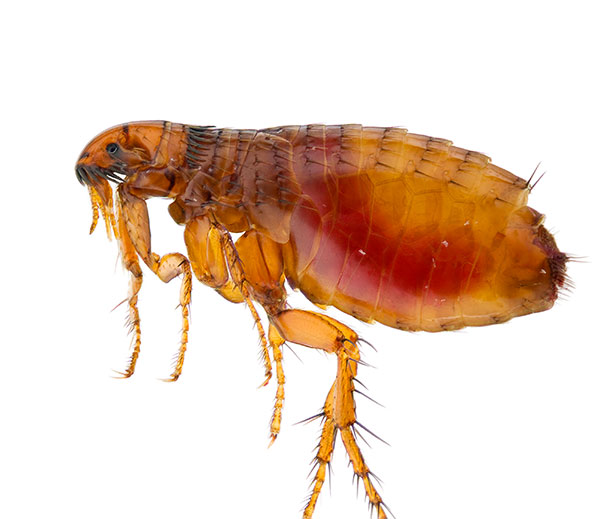
Fleas (Ctenocephalides canis) are holometabolous, meaning they pass through the following stages: egg, larva (three larval instars), pupa, and adult.
Dog flea life cycle
The life cycle of Ctenocephalides canis can be completed in two to four weeks, which may lead to multiple generations within a single year. Adults are therefore present on host animals year-round, with the population peaking in late summer and/or early fall.
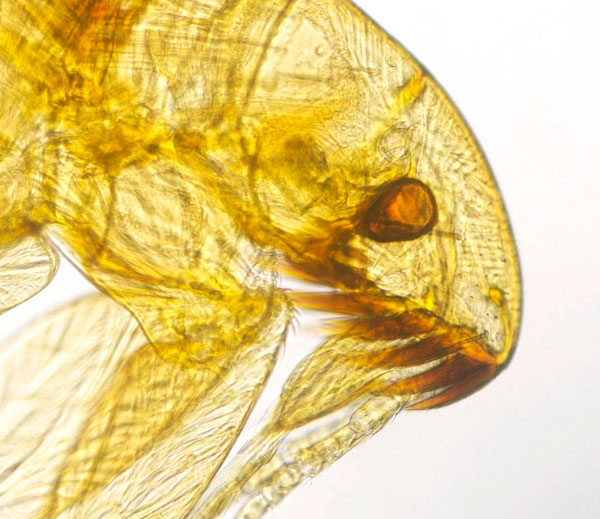
Adult dog fleas are small (2.0–3.25 mm), wingless, laterally compressed, and heavily chitinized. They have genal and pronotal combs, large black eyes, and 5-segment labial palps.
Although dog fleas and cat fleas look very similar, the comb along the ventral margin of the head (the genal ctenidium) is used to distinguish Ctenocephalides canis from the cat flea, Ctenocephalides felis. The size of the first two genal spines also differentiates the two species: in Ctenocephalides canis, the first (outer) genal spine is much shorter than the second; in Ctenocephalides felis, the first genal spine is as long as, or only slightly shorter than, the second.
Dog flea reproduction
A blood meal is required for a mated adult female flea to produce and lay eggs. A single female flea can produce hundreds of eggs over the course of her life. Flea eggs are 0.1 to 0.5 mm long, pearly white, oval, smooth, and non-sticky.
Females lay eggs continuously while on the host. According to a study by Baker and Elharam, egg hatching is most successful at 25°C and 75% humidity. Under these conditions, hatching occurs in three to four days; however, eggs may take up to a week to hatch.
Habitat: where we find them
Fleas can live on any warm-blooded animal, but they seem to prefer humans, cats, dogs, opossums, rats and other rodents, as well as coyotes, wolves, marmots, rabbits, gray foxes, and red foxes. They can also be found on shoes, pants, or blankets, in kennels, and in places where there are animals to infest.
Dog flea diet
Fleas feed only on the blood of humans or animals. They also need blood to reproduce, but flea larvae have very different dietary needs compared to adult fleas, which feed only on fresh blood.