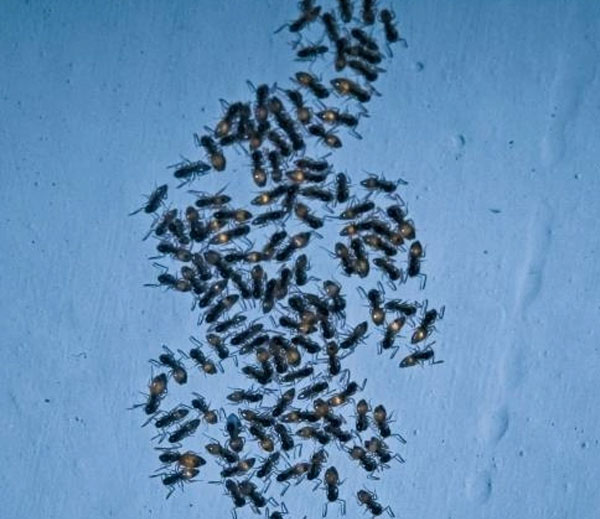
Tapinoma melanocephalum is a domestic pest. It can invade homes from outdoors, nest indoors, and contaminate food sources.
Characteristics of the ghost ant
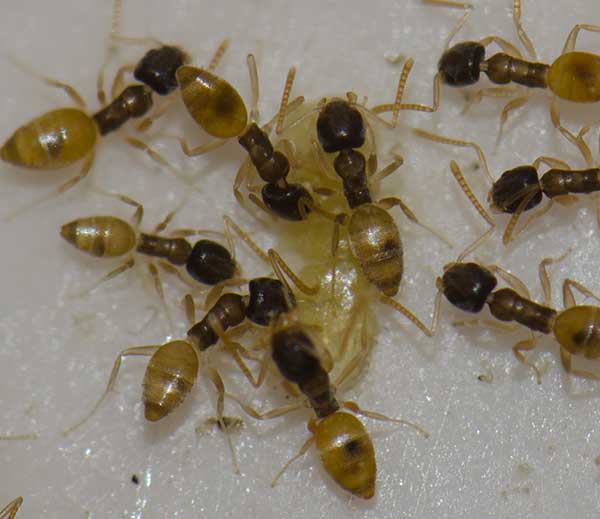
Workers of Tapinoma melanocephalum, commonly known as ghost ants, are extremely small, measuring between 1.3 and 1.9 mm in length, and are monomorphic. They have 12-segmented antennae that gradually thicken toward the tip. The first segment of the antennal funiculus is longer than the second and third segments combined.
The antennal scapes extend beyond the occipital margin. The species is distinctly bicolored: the head (including the antennae, except for the first two segments) and the sides of the mesosoma are dark brown to black, while the body and legs are opaque or milky white, giving the ant its characteristic “ghost-like” appearance.
This species has four segments on the dorsal surface and a slit-like, hairless anal opening. The eyes are large, each with 9 or 10 facets along their long axis. Each mandible has three large teeth and approximately seven smaller denticles. Stingers are absent.
The very small size combined with the pale coloration makes this ant difficult to detect. When crushed, workers emit an odor similar to rotten coconut.
Reproduction of the ghost ant
Tapinoma melanocephalum forms polygynous, unicolonial colonies that can create individual nests containing between 100 and 1,000 individuals.
Colonies usually occupy local sites that are too small or unstable to support large single colonies, so they divide into subunits occupying multiple nesting sites.
There appears to be little or no aggression between members of different colonies or nests when they originate from the same area. Queens have a very short lifespan, only a few weeks, and multiple queens may be distributed among different subcolonies.
Habitat: where they are found
Ghost ants often occupy temporary habitats such as plant stems, clumps of dry grass, debris, and beneath potted plants. They migrate easily when disturbed or when conditions become unfavorable.
Diet of the ghost ant
Like other ant species, ghost ant workers collect food and carry it back to the nest.
Adult ants cannot consume large food particles because their esophagus is very narrow and allows only liquid or extremely small food particles to pass.
Larvae, on the other hand, have sharp teeth that enable them to chew solid food brought to the nest by adult workers.
Unlike many animals in which the mother regurgitates food to feed her young, ants do the opposite: adult ants often obtain partially digested liquid food regurgitated by the larvae.